

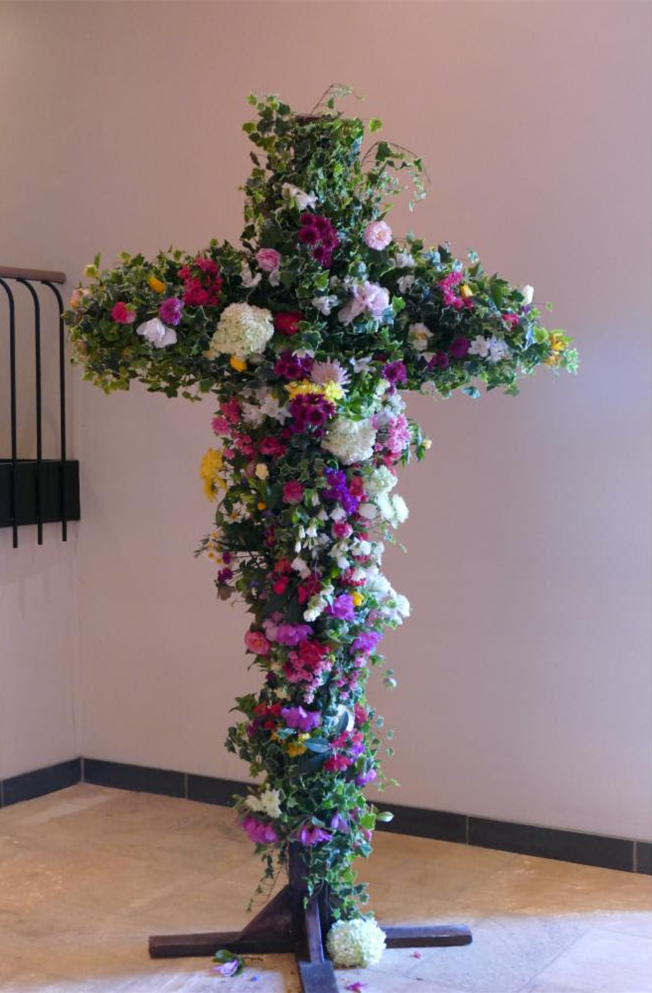
The Flowering of the Cross has become a tradition in many churches. On Easter Sunday morning, worshippers bring flowers to be placed on a wooden cross that either has pre-drilled holes for the flowers or has been wrapped in a wire “cage” into which the flowers are inserted. The idea is to change the ugly cross into a beautiful “new creation.” The flowered cross provides the backdrop for many family pictures each spring. I am not criticizing the tradition of flowering the cross. I have participated in it and have found it meaningful, as long as I don’t over think it.
At least one church I know of calls the flowered cross “The Living Cross.” I find it ironic that a cross covered in cut flowers, i.e., dead flowers, is called a “living cross.”. Initially, the flowered covered cross is beautiful, usually filled with a variety of flowers contributed by young and old from various backgrounds and walks of life. This aspect of the tradition is symbolic of what the Church should be. Realistically, even if the flowers had not been cut, if they had remained connected to their source of life, eventually the flower would die. Before its death, the connected flower serves the plant by attracting insects that pollenate the plant, in time enabling the plant to produce fruit. The fruit enables the plant to perpetuate the species. After the flowers die and drop from the plant, they return nutrients to the soil which allow their plant and other plants to thrive. This, too, is as the church should be—each member contributing to the good of the whole and to the ongoing Kingdom of God. Once the flowers are cut, they are no longer connected to their vines, branches, and ultimately their roots, they no longer receive the nourishment and nurturing they need to continue to live and grow. In a short amount of time, the reality that these flowers are dead begins to show. They wilt; their colors fade; they become dry and brittle; and, most often, they are thrown away. Most are not even composted. As beautiful as cut flowers are, and as much as I enjoy them, the truth is that the primary purpose of flowers is not to provide decorations for humanity. As is true for so much of life, flowers are not about us, i.e., humans. (cf. John 15:1-6)
I find that my life is often more similar to that the flowered cross and its dead flowers than I want to admit. It is easy to compare the cross that only appears and is decorated on Easter to the people who come to church only on Easter. (The really devoted of this group may also come to church on Christmas Eve. If their mothers are really good at producing guilt trips, they may even come to church with them on Mother’s Day.) Of course, I am not like them. I come to church almost every Sunday. I read my Bible, at least occasionally. I pray, especially when I need God’s comfort or help. My faith is living—or is it? Am I really connected to God or have I learned merely how to appear to be a “good Christian”? Does my life attract others to God in such a way that they can be nourished? Does my life enable others to learn and carry God’s love, grace, and mercy beyond my sphere of influence, to carry love and healing into a world too full of hate and hurt? Does my life produce fruit that will help the Kingdom of God to grow and flourish? How often do I remember that this life is not about me? Yes, life is precious. Yes, God wants us to enjoy life abundantly. (John 10:10b) We cannot do that apart from God. We were created for God and God’s Kingdom, not the other way around.
The Flowering of the Cross is a beautiful Easter tradition. Let us remember that the story did not end at the cross or even with the resurrection. The story of Easter is indeed a living story and God has given us the privilege to have a role in that story. Unlike the flowers, we get to decide whether we stay connected to the plant (God), whether our lives and earthly deaths contribute to new life and growth. Are we dead or alive?
 Maggie Lou's Musings, Lessons, and Blessings
Leave a comment